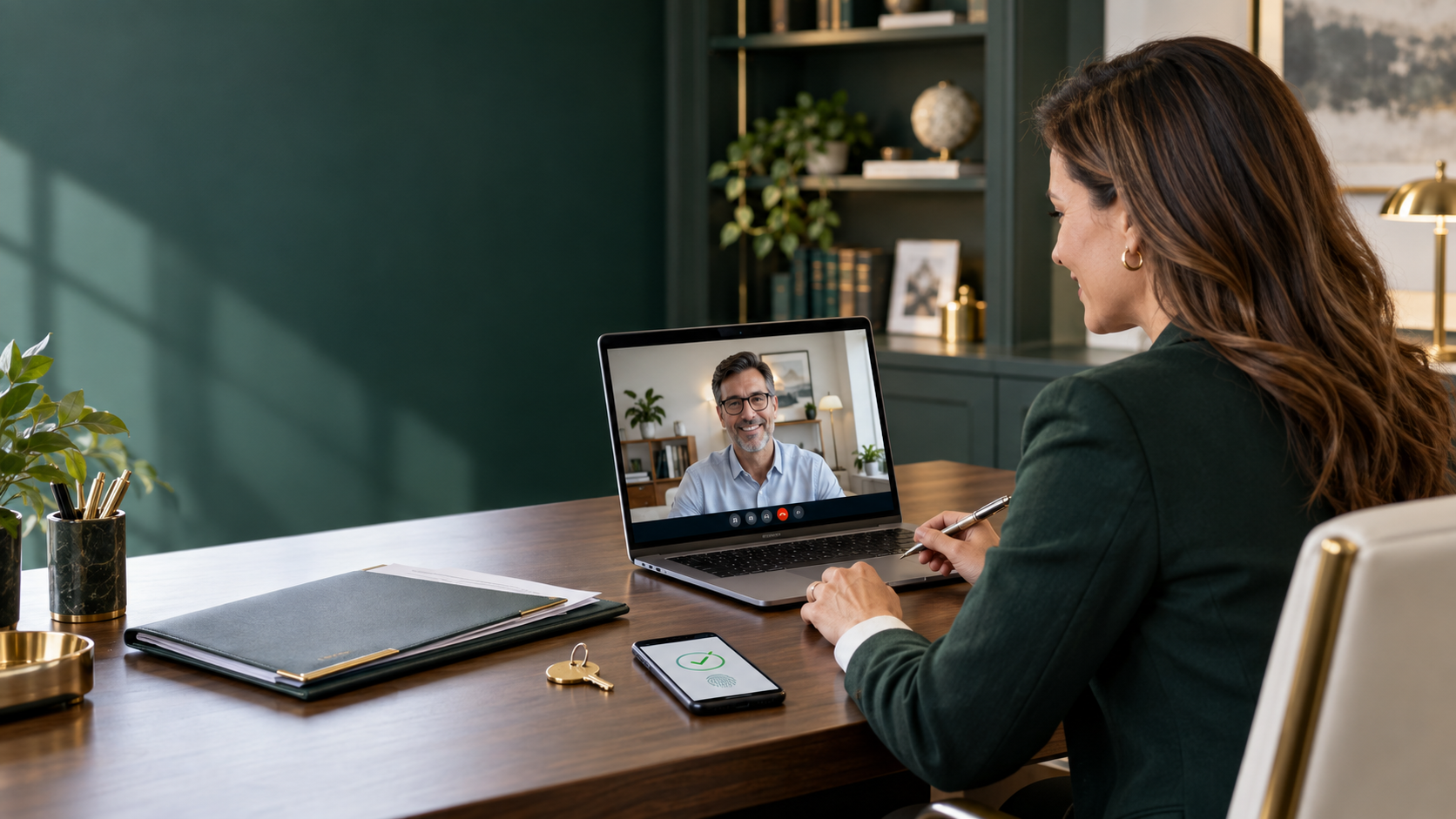
What remote online notarization is
Remote online notarization (RON) lets your signers complete a notarization with a commissioned notary over a secure, live audio-video connection instead of meeting in person. The documents, signatures and notary seal are all electronic, and every step is verified, recorded and logged.
For title companies, escrow officers, attorneys and real estate agents, that means fewer scheduling headaches, no hunting for a mobile notary in a distant town, and a closing package that comes back complete, with proof of exactly how it was signed. Here is how it works, and why it is one of the most secure ways to close today.
Multiple layers of identity verification
A RON session verifies each signer through several independent checks before the notary ever applies a seal. A fraudster would have to defeat every layer at once, which is far harder than presenting a fake ID across a kitchen table.
- Credential analysis. The signer photographs the front and back of a government-issued photo ID. The platform’s software inspects it for security features, formatting, data consistency and signs of tampering, and confirms the ID is valid and unexpired.
- Knowledge-based authentication (KBA). The signer answers a short set of multiple-choice questions drawn from public and credit-history records, such as past addresses, vehicles or loans. The questions are timed, and a signer who fails two attempts is locked out for 24 hours.
- Biometrics, in states that allow it. Some states permit biometric checks, such as a facial match comparing the signer’s live face to the photo on their ID. Where allowed, this adds one more layer that is very hard to fake.
- The notary’s own review. Technology does not replace the notary. The notary sees the signer live on camera, compares them to the ID, confirms they understand what they are signing, and watches for any sign of coercion or confusion. If something does not feel right, the notary can stop the session.
Only when every required check passes does the signing move forward.
Every session is recorded, start to finish
The entire RON session is captured on audio and video, from identity verification through the final signature and notary seal. That recording is retained as required by the notary’s commissioning state.
For a title or escrow company, this is a built-in safeguard a paper closing cannot offer. If a signer later claims they did not sign, did not understand the documents, or were pressured, there is a complete record of who was present, what was said and what was signed.
Multiple signers, one session
RON lets every signer on a transaction join the same session with one notary, even when they are in different cities, states or time zones. Each signer is identity-verified individually, and everyone signs in a single sitting.
That eliminates the need to book separate notaries for each signer, wait for split packages to come back, and piece the file together afterward. One session, one notary, one complete package.
Signers can be anywhere, even overseas
Your signer does not need to be near the property, or even in the country. A buyer on military deployment, a seller living abroad, or an heir overseas can meet the online notary from wherever they are, as long as they have a computer or device with a camera, microphone and internet connection.
The one firm rule is on the notary’s side: the notary must be physically located in the state that issued their commission at the time of the notarization. A Tennessee RON notary, for example, performs the session from inside Tennessee, no matter where the signer is sitting.
Closing in California? We can help
California notaries are not yet allowed to perform remote online notarizations. However, California signers can use a RON notary commissioned in a state that does authorize it.
We handle many California closings online. Your California signers meet one of our notaries from home, complete the same layered identity verification, and the package comes back to you just like any other RON closing.
Witnesses provided when required
Some states require one or two witnesses on real estate documents such as deeds and mortgages. If your documents come from one of those states, we can provide the online witnesses for you. They join the same live session, watch the signing, and sign electronically, so the package meets the witness requirement without you having to find anyone.
Attorneys, title officers and realtors are welcome to join
A notary is an impartial witness and is not legally permitted to explain documents, give legal advice or answer questions about loan terms. When a signer has those questions at a paper closing, the signing often stalls while someone tracks down the right person.
With RON, the attorney, title or escrow officer, or real estate agent can simply join the session alongside the client. If a question comes up, the right professional answers it on the spot, and the signing keeps moving.
Your completed package, delivered securely
When the signing is finished, the title company receives the completed, notarized package along with the audit trail, sent back through a secure email portal. No overnight shipping, no lost FedEx envelopes, and no waiting days for originals.
The audit trail documents the transaction step by step, including the identity verification results and the time each action was taken. Combined with the session recording, it gives you a clear, defensible record of the entire closing.
Ready for recording
We can prep your documents so they are e-recordable the moment you receive them, with no reformatting needed on your end.
If the county requires paper recording, papering out an electronically notarized document takes one extra step. We can help you with that step too, so your recordable documents are accepted without delays.
A RON closing, step by step
- You send the documents. The title or escrow company emails the documents to the notary or uploads them to the notary’s secure portal, along with each signer’s name and contact information.
- Signers get a secure link. Each signer receives an invitation to join at the scheduled time from their own device. We work on trusted RON platforms including NotaryCam, Proof, Blue Notary, and SIGNiX.
- Identity is verified. Each signer completes credential analysis, KBA, and, where allowed, biometric checks.
- The live session begins. The notary, all signers, any required witnesses, and any invited professionals meet on video.
- Documents are signed and notarized. Signers sign electronically while the notary watches, then the notary applies an electronic signature and seal.
- The package comes back to you. The completed documents and audit trail are returned through a secure email portal, with the session recording retained on file.
Find a vetted RON notary
Escrow Notary Network connects title companies and escrow officers with experienced, vetted remote online notaries. Whether you have one signer across town or several signers across the globe, our members can close it in a single, secure, fully recorded session. Find a notary at escrownotarynetwork.com.